
Midland Community Gardens provide for those facing food insecurity
Midland’s community gardens are helping fight food insecurity by growing and donating fresh produce to local food pantries. Powered by volunteers, the gardens provide thousands of pounds of fruits and vegetables to families in need each year.
As the calendar page turns to July, the bounty of vegetable gardens around the area begins to emerge. Whether it’s a large, fenced-in space or just a few containers on the patio, there’s an undeniable soul-filling feeling a person gets when growing food for oneself, family, and friends.
Take this idea a step further, and abundance spreads in the form of a Community Garden, “a piece of land cultivated by a group of people individually or collectively” (Wikipedia). At least four such gardens exist in Midland, all with the mission of providing fresh produce to residents facing a “hidden nutrition crisis.”
According to the non-profit Feeding America, 13.7 percent or approximately 12,540 Midland County residents faced food insecurity in 2024 and with the rising cost of groceries, that number is likely even higher now.
Assumption of the Blessed Virgin Mary Garden
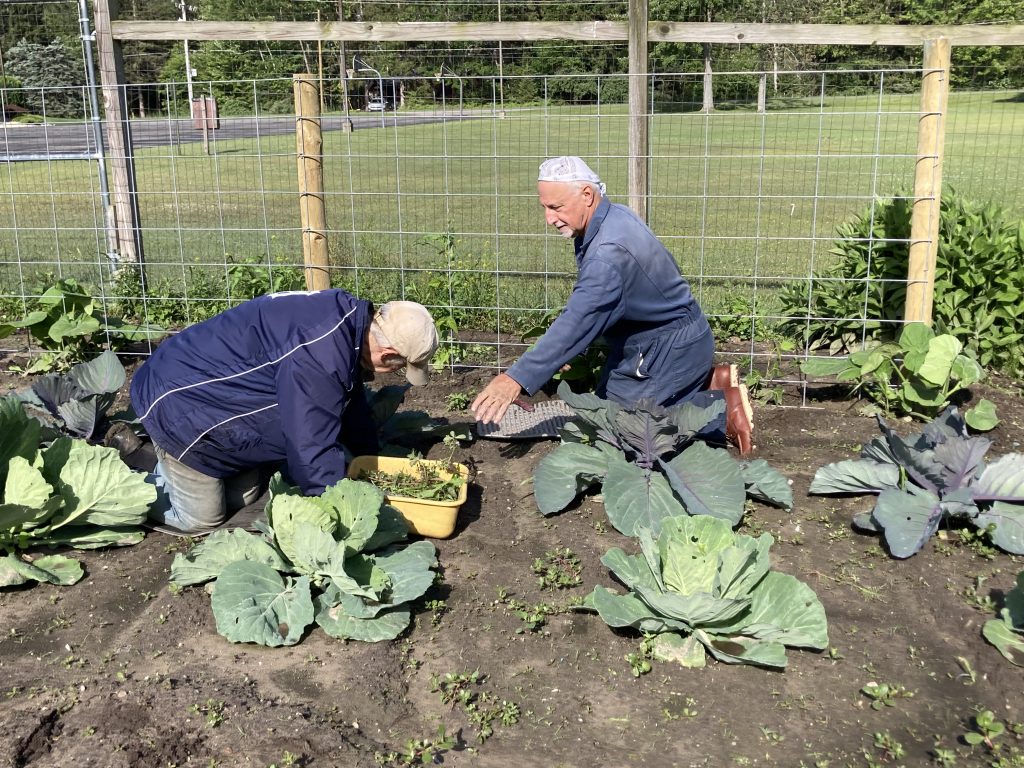
“Look at this land. Why not put it to good use?” asks Bernie Link, as he looks out over the expanse of land to the north of the parish on Monroe Rd. Bernie, retired from research and development, along with his wife Michele, a retired teacher, assumed leadership and coordination of the garden around 2017.
Initially located at a parishioner’s home, the garden’s genesis goes back as far as 2009, but it wasn’t until several years later that it began at its current location. Bernie says the garden is roughly 130’ x 65’ and grows the usual vegetable garden fare, from beans and broccoli, to carrots and cabbage. Bernie says crop selection is based on need and what people will eat.
“A single mother with three kids and a job needs to stretch the food out and have it ready quickly. We try to go with nutritious crops that grow well and people want,” he says. “Butternut squash, for example, grows big and is great for families.”
Bernie gets the plants and seeds from Kutchey’s. “I turn in a list to Kelli (Piotroski, owner), and she takes it from there.”
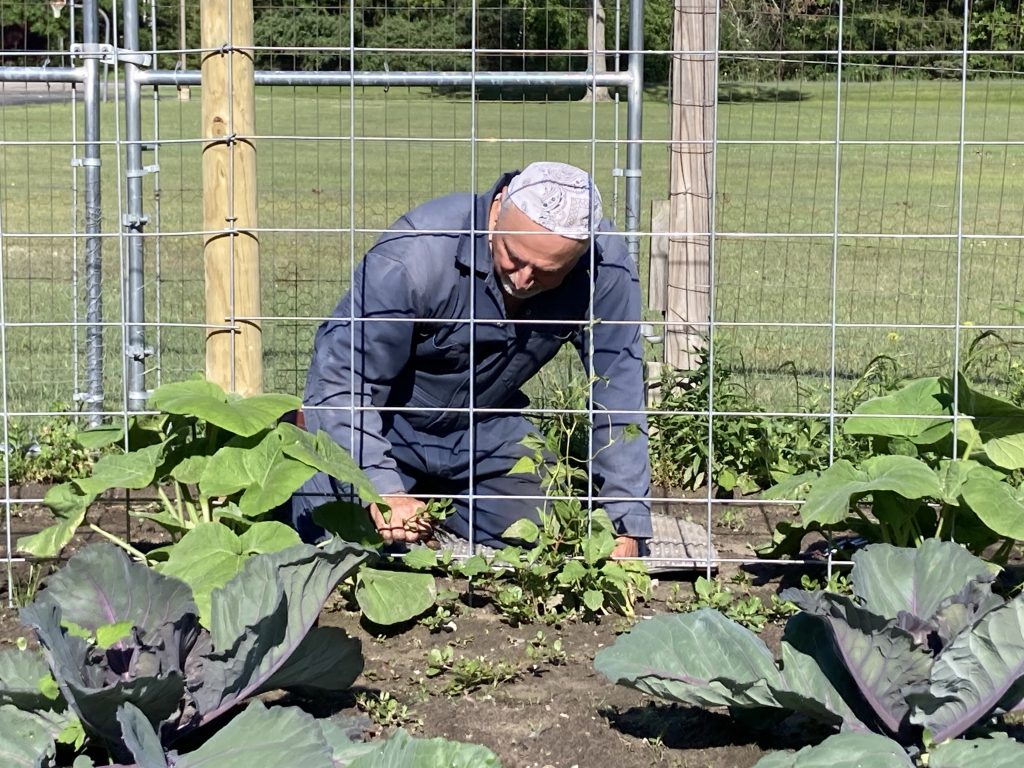
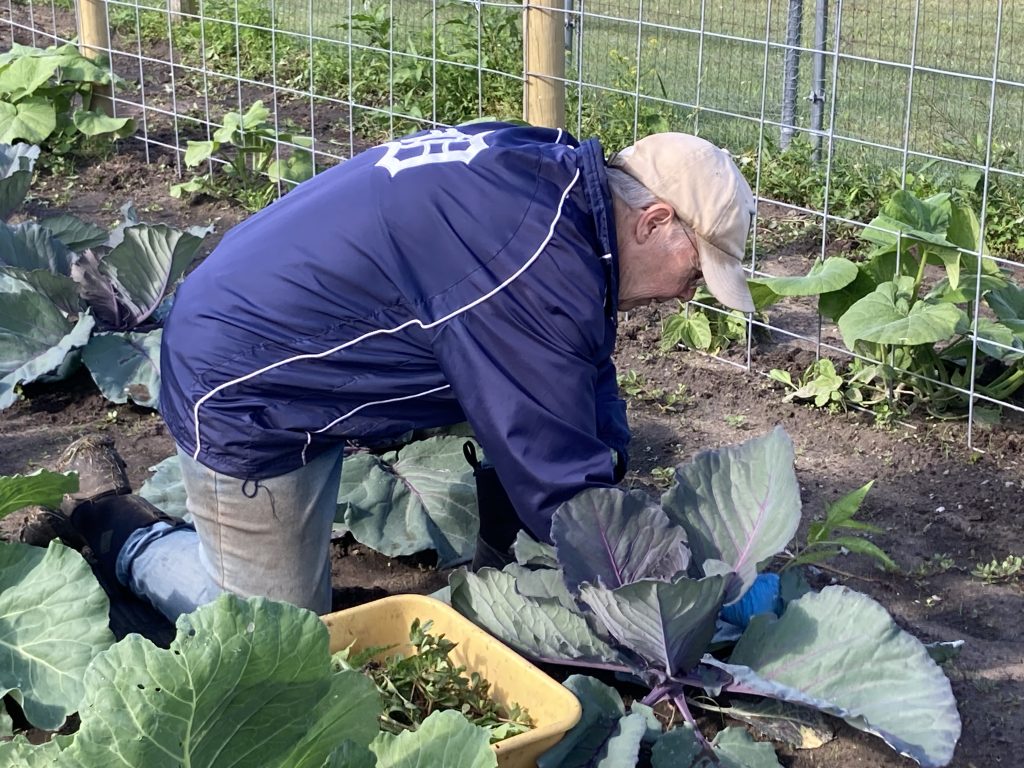
Fenced in with a traditional layout of rows, Bernie says the garden’s success relies on six or seven committed volunteers. Faced with the usual challenges of disease, bugs, water, heat, and germination, Bernie says, “We have to be vigilant and pay attention to the natural process.”
Harvests occur twice a week during the growing season. In the past, the garden yielded around 1,000 pounds of produce annually. Bernie says Michele set up a partnership with Hidden Harvest; they pick up the produce grown on Tuesdays, as well as produce provided by parishioners from their own gardens, and distribute it to area pantries according to need. Volunteer Bob “the Mule” Lane harvests on Saturdays and takes the vegetables to The Bridge Food Center.
An old, weathered sign hangs near the fenced-in entry to the garden asking for prayers from Saint Isidor, the Catholic patron saint of farmers, peasants, and rural communities. Bernie says, “It’s work, but I’m really happy with how well this garden does.”
Circle Area Community Garden
Formerly run by the City of Midland’s Parks and Recreation Department with 30 individual plots rented to individuals for their own use, the Cambridge St. garden is now under Gina Malczewski’s leadership and financially supported by the American Chemical Society (ACS). Gina, a retired biochemist and a member of ACS, along with her three-member team, has transformed the space into a ‘giving garden’ with produce going to The Caregiving Network, The Bridge Food Center, and the Midland County Food Assistance Network (MCFAN). MCFAN has eight pantry sites in the county.
According to a plaque posted at the garden, this land was formerly part of the Bergstein’s Community Drug Stores Ashman Circle location, and was gifted by them for “use as a permanent community garden.” When the city found the garden too expensive to run, they approached Gina, who has community garden experience. She says, “I was just thrilled about this space. I couldn’t believe it. It was all laid out with a nice shed. Plus, we had the freedom to do what we wanted.”
Before getting to the planting, Gina says the group spent some time removing some invasive plants like Wild Fennel. “You can’t let it go, or it will take over,” she says. While they have flowers toward the back of the garden, Gina says she wants most of the space for food. The group took over the garden just this past April, so there was a lot to do in a short amount of time. “It’s all planted now, though,” Gina says. She buys the plants and seeds wherever she can find them at a good price, and also received some items from Kelli at Kutchey’s.
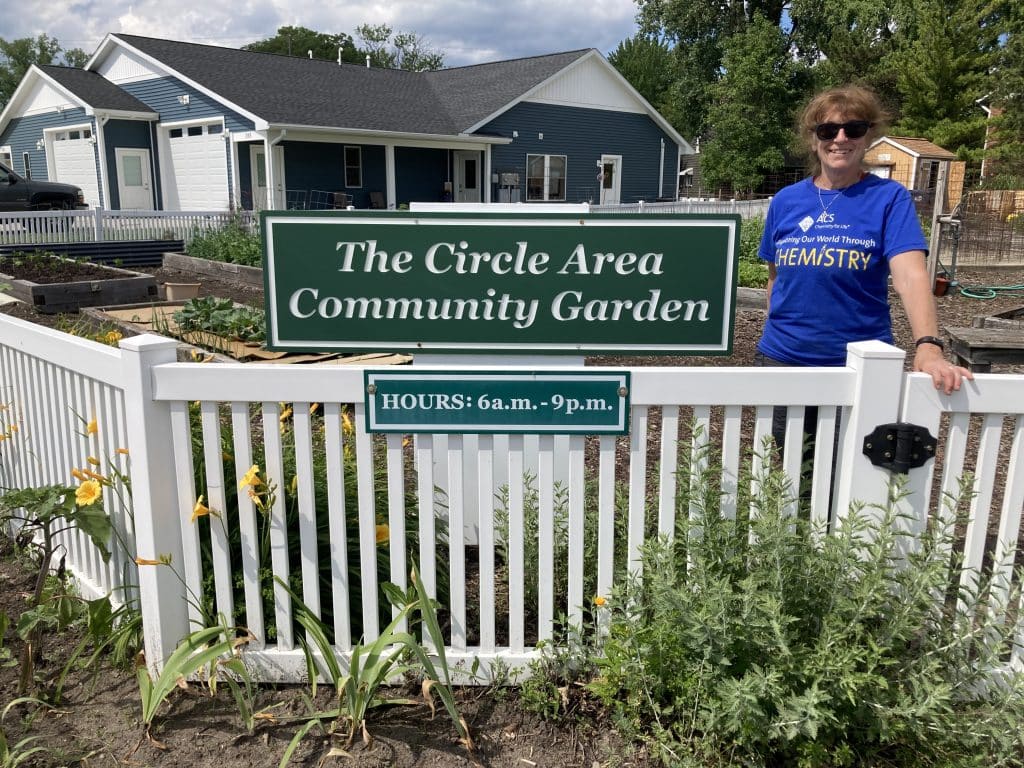
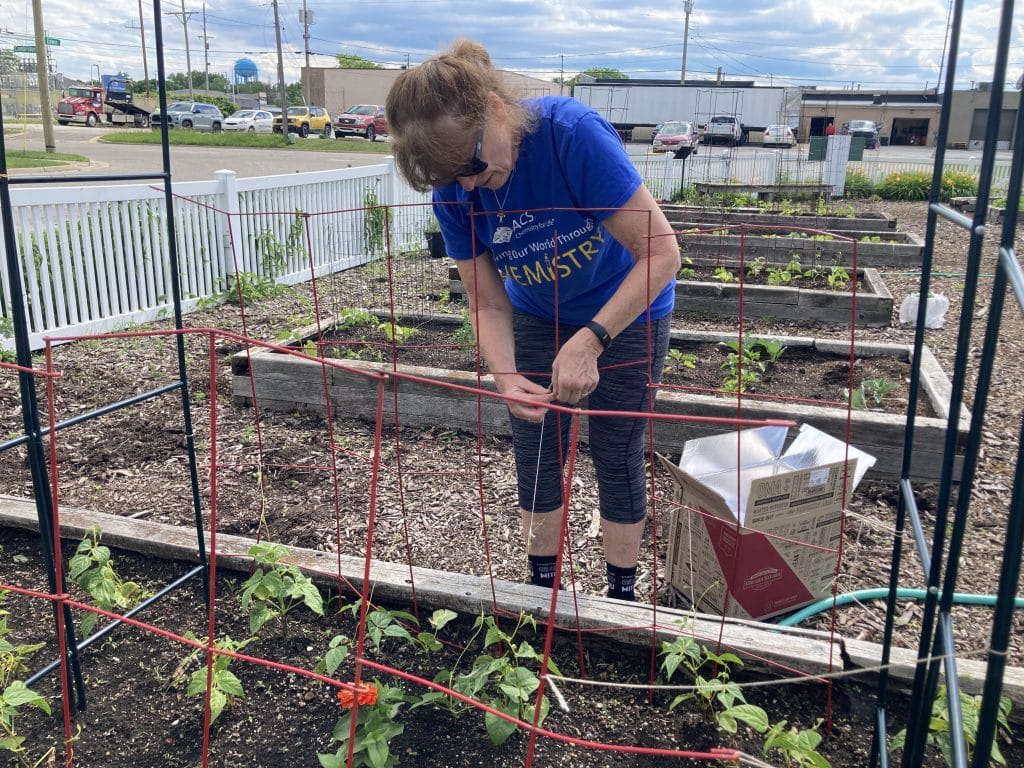
How much we hope to grow is somewhat of an unknown, being the first year at this space. At a garden she tended in the past, “We weighed everything, I kept a spreadsheet, and I knew who got everything,” a practice she says will continue at the Circle Garden. Regardless, “people at the pantries all seem very appreciative.”
While Gina and her three-person crew do all of the gardening tasks, the City of Midland partners with them by providing water, wood chips for the paths, yard waste collection, and grass mowing. “The City has been wonderful,” Gina says. “They seem pleased, and I’ve had very efficient communication with them.”
As she looks to the future, Gina hopes to have something to provide shade in order to eventually host programming at the garden. “I enjoy gardening and seeing things grow,” Gina says. “It’s fun to grow your own things, but it’s even better when you can show the benefits of growing things to help other people.”
First United Methodist Garden – Carpenter School
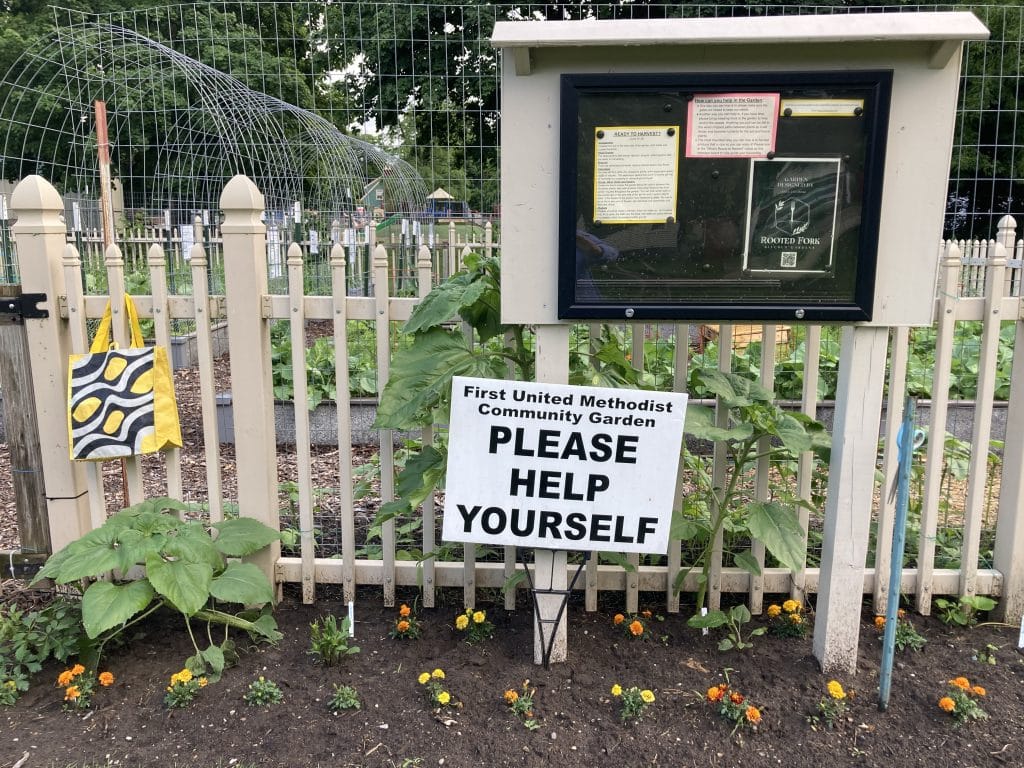
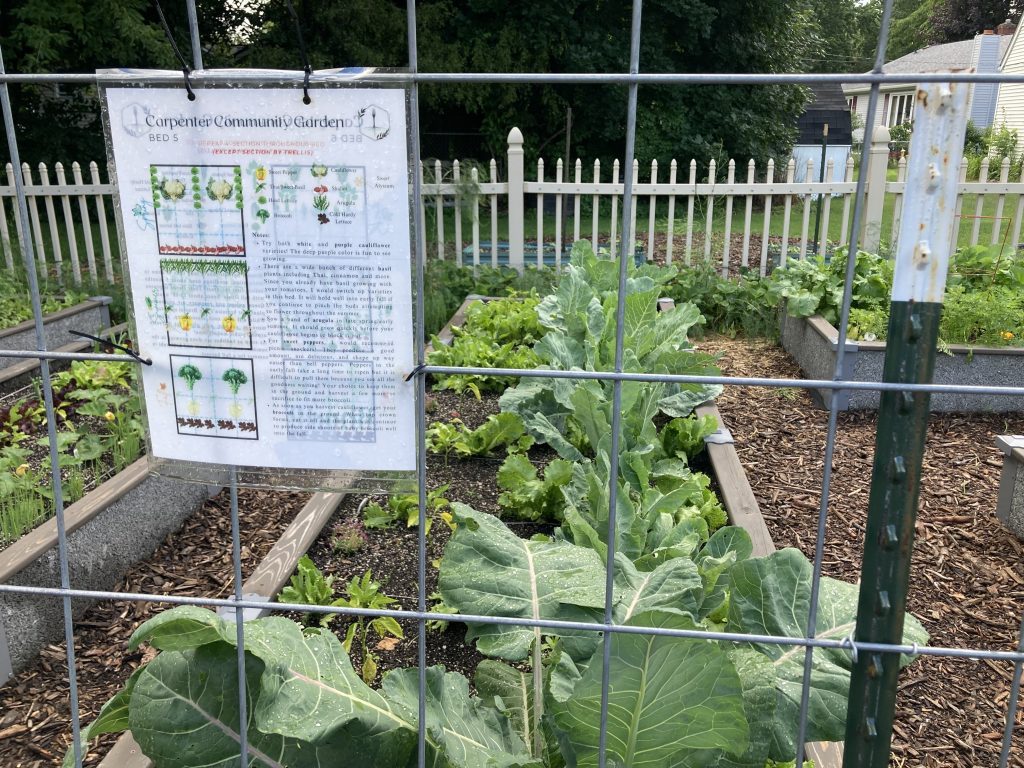
This beautiful garden boasts a sign inviting all to “Please Help Themselves.” The garden is well organized with signs and instructions for what, when, and how to harvest. Scissors and bags for harvesting hang from the gate entry with a sign asking only to close it when leaving so the rabbits don’t get in. Organizers were unavailable for comment.
Midtown Mission Garden – Memorial Presbyterian Church
This garden started in 2017, and like the Circle Garden, began with having to remove invasives, in this case, Buckthorn. And while they now irrigate with timed sprinklers, they originally hauled water in buckets from the church building across Ashman St.
Harry Wertman, a retired mechanical and electrical engineer, says he coordinates the garden, while Bill Schramm, a retired senior management leader with Henry Ford Hospital in Detroit, runs it, leading the operations since 2018. Bill’s son, Matt, is the pastor at Memorial Presbyterian.
Supported through a church endowment, the garden is about 100’ x 40’ and like the Circle and Assumption gardens, boasts an array of produce. Bill says they grow five varieties of blueberries that will yield about 20 pounds of berries per bush, and also have eight varieties of tomatoes, 40 plants total.
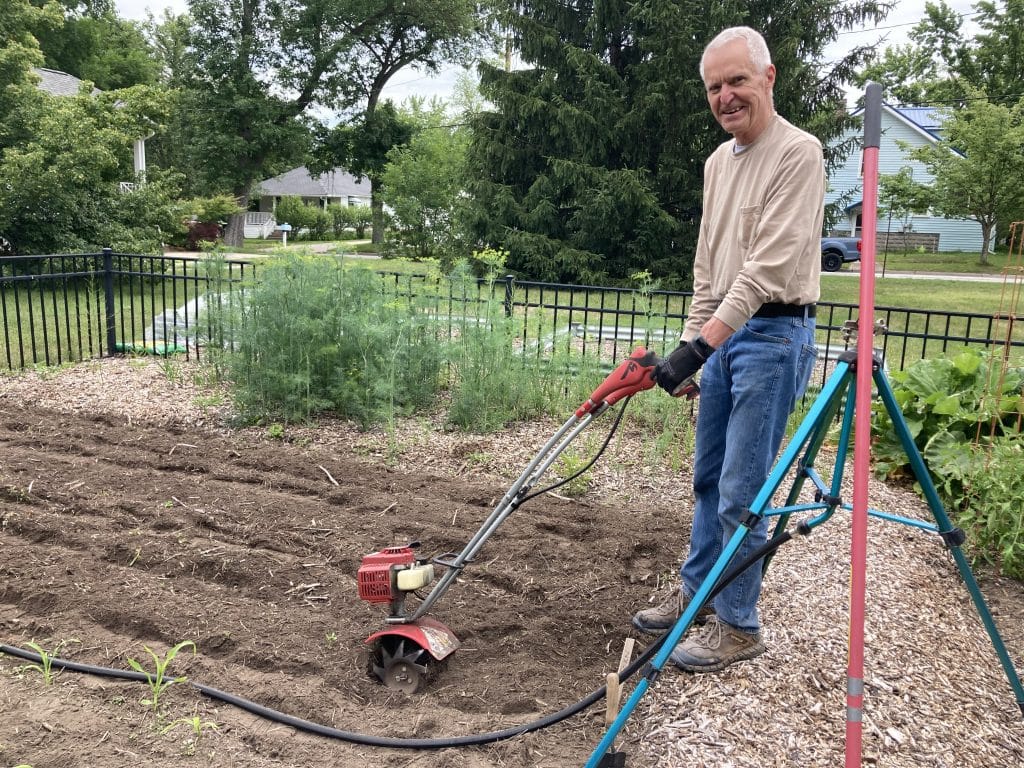
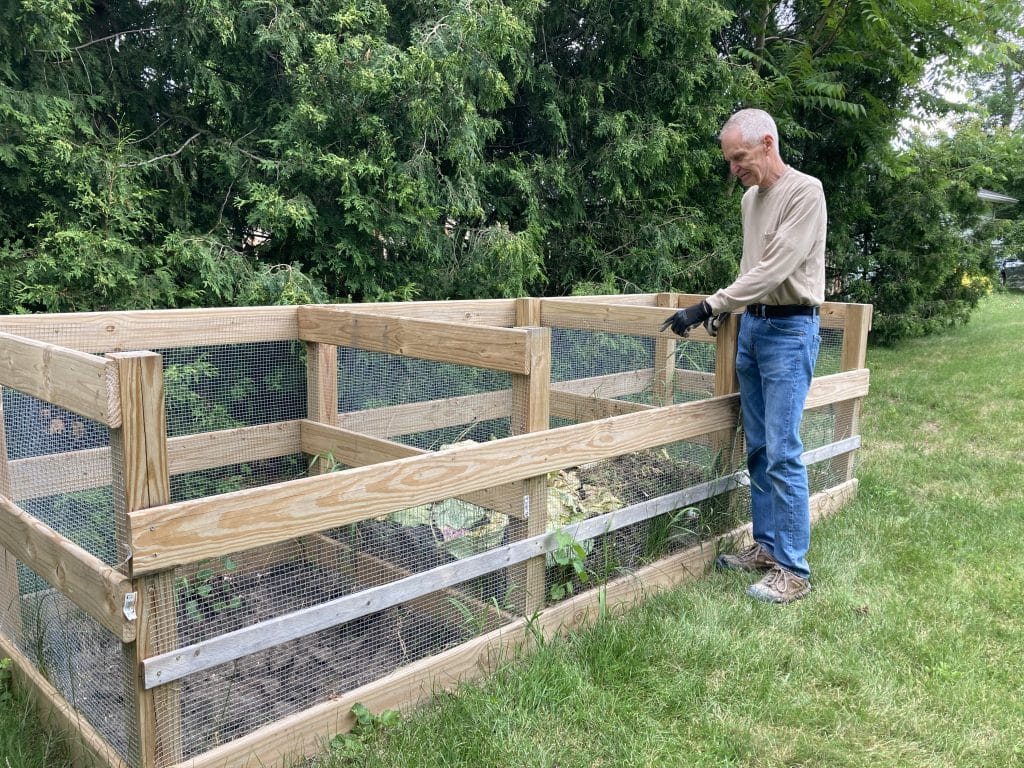
“Last year the garden grew about 2,000 pounds of food, with larger amounts going to The Bridge Food Center and smaller amounts going to The Open Door,” Bill says. But that kind of yield doesn’t just happen. “We have eight regular volunteers who come at least weekly. The garden is divided into four sections with a two-person team overseeing each one,” Bill says. He gives them a map of what, how, and where to plant, rotating crops around from year to year.
Congregation members also help by attending “garden parties” where they weed and are treated to chips and hot dogs. Weeding is essential here as it is in all of the gardens. Bill says, “One tuft of crabgrass can produce 100,000 seeds.”
Bill has gleaned much of his knowledge by volunteering at Dow Gardens and by having his own garden since 1976. He gets all of the garden’s seeds and plants from Cohoon’s Elevator. “I get quality there, and they stand behind it. They quality test all of their seeds,” he says.
Asked what the best part is of tending the gardens, Bill quotes Jesus from John 21:15, “Feed my lambs.”
Harry says, “I had an epiphany with the garden after meeting with Marsha [Stamas, manager] at The Bridge Center. I had a tour and saw how they used the food from the garden. She said nobody takes the last item because they think there’s someone else who needs it more. That changed me right there . . . It feels good to give this produce to people who have food insecurity.”
In addition to food insecurity, MLive reports that in 2024, according to the non-profit United for ALICE (asset-limited, income-constrained, employed), 35,687 or 34.5 percent of Midland County households can’t afford basic needs like housing, food, and healthcare. If you would like to volunteer in one of these gardens or food pantries, contact the respective churches and organizations. Membership and affiliation are not required.
Author

Related Articles
The seasons are changing, but farmers market days aren’t over yet
As summer gives way to fall, farmers markets across the Great Lakes Bay Region are still going strong, offering fresh produce and local goods before the season winds down.
Dream Dress Express returns with free formalwear for homecoming season
Greater Midland North Family Center will host its annual Dream Dress Express Aug. 27-29, offering more than 3,000 free dresses, shoes and accessories to community members preparing for homecoming and other formal events. Appointments are required, but there are no income or residency requirements.

River Days returns to downtown Midland this week
Hot air balloons, live music, family activities and fireworks will return to downtown Midland as River Days celebrates its annual four-day festival July 30 through Aug. 2.


